
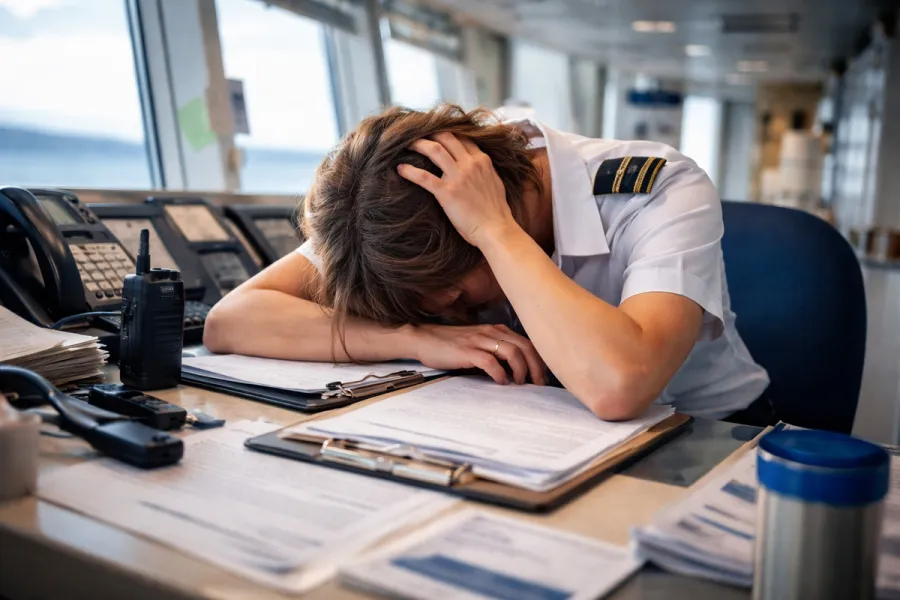
Burnout is not just feeling exhausted after a long shift. It is a deep state of physical, emotional, and mental collapse caused by months of nonstop pressure, overwork, and lack of support. When it takes hold, people may feel anxious, disconnected, unable to sleep, and overwhelmed by even the smallest tasks.
For cruise ship crew, burnout is not rare. It is a constant risk.
Life on cruise ships is built around long contracts, shared cabins, limited privacy, and demanding schedules. Many crew members work long hours a day, seven days a week, for months without a proper day off. Rest is often interrupted. Personal space is minimal. Mental health support is scarce.
Crew are expected to deliver perfect service, meet tight deadlines, cover staff shortages, and take on extra duties. Mistakes are remembered and appreciation is rare.
In this kind of workplace, burnout is not an exception.
It is a warning sign.
One female crew member, who asked to remain anonymous, shared her story with us to help others understand what burnout at sea really looks like.
After finishing a contract and returning home, she expected to finally rest. Instead, her body and mind collapsed.
“I was so exhausted that I couldn’t sleep,” she told us. “For three days, I barely rested. My head was racing. I felt hopeless and desperate.”
In that state of extreme exhaustion, she took sleeping pills — and nearly lost her life. Paramedics rushed her to intensive care, where doctors later diagnosed her with severe burnout.
“If they hadn’t arrived in time,” she said quietly, “I wouldn’t be here today.”
A Slow Breakdown
Her collapse did not happen overnight.
It was the result of years of pressure, understaffing, and workplace hostility.
Working in Media and Printing roles, she was often the only person responsible for producing personalized materials for hundreds of guests — including menus, newsletters, signage, letters, and digital content. The workload was relentless.
Instead receiving support, she was frequently met with intimidation and criticism.
“I was working a minimum of 12 hours a day and sometimes 15 or 16 hours, doing the job of 3 people. I was so exhausted and depressed I couldn't even eat properly, I lost weight, I was looking miserable, and to add up the payments they done for me for the extra duty was different from Islander the previous ship I was inside the brand - I had a contracting splitted in 2 of their ships - there we were without the print shop and I performed both duties but I was paid properly for that, without anyone even asking me.
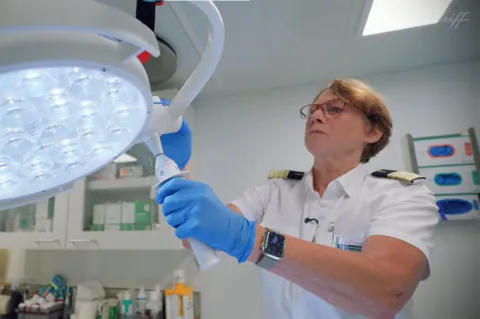
Paradise HR claimed I was never in my office, because I used a laptop, so sometimes I would work from different spots, my office was a horrible, dirty and noisy environment (instead of a door there is a cage, just to picture it), not even PA system inside) but because of HR claims they obliged me only to work from there always, 14/15/16 hours in this place. It was the perfect recipe to collapse, onboard I started feeling a pressure in the chest constantly, the medical team never took it seriously, I had migraines and I started to get sick more often, but all was ignored only given regular meds and that's all, there my mind and body were already asking for help, the chest pain was so big sometimes I would even think could be a heart attack, but they would only check my vitals and send me back to work.“
False accusations by management were resolved only after intervention from senior leadership.
“HR, Captain and HR were claiming I faked my own job description to not do the job, which i never said i wouldn't do it, they started to put words in my mouth when I was always cooperative and friendly (in the end i wasn't so friendly anymore), the VP operations manager had to call them to explain that I was right and my position was correct.”
Following the resolution, the crew member faced retaliation through increased scrutiny, denied requests, and unexplained changes schedule.
“After that I had some peace but the retaliation begun, drug and alcohol "random" test, then I got a flight 3x longer than usual, denied requests, and after I came home they suddenly change my rotation and didn't even explain themselves to me. “
Reaching the Breaking Point
By the time she returned home, she was exhausted beyond words.
“I couldn’t sleep without pills. I was hallucinating from lack of rest. I felt like I was losing myself.”
Then came the collapse.
Her near-fatal encounter was a desperate attempt to escape unbearable exhaustion.
Doctors recognized it immediately: severe occupational burnout.
“I’m Still Here”
Today, she is rebuilding her life.
Sharing her story is part of that healing.
“I don’t want revenge,” she said. “I want change. I don’t want anyone else to go through this.”
She speaks openly about safety issues that were ignored, equipment that wasn’t secured, and systems that failed to protect workers.
She also speaks about hope.
“I survived. I’m still here. And that matters.”
A System That Must Change
Her story is not unique.
Across the cruise industry, thousands of crew members face similar pressures: long contracts, understaffed departments, limited mental health support, fear of retaliation. Most endure in silence.
Until they can’t.
Burnout is not weakness. It is what happens when dedicated people are pushed beyond human limits.
Behind every smiling crew member is a real person — with a family, fears, dreams, and breaking points.
The industry owes them more than gratitude.
It owes them dignity, protection, and care.
If you are a crew member struggling with exhaustion, anxiety, or despair, please know: you are not alone. Speaking up is not failure. Asking for help is strength.
And your life is worth far more than any contract.
Crew Insights
Articles and experiences shared by crew members working on cruise ship. Find out more about ship life at sea together with tips and advices for first time crew members and cruise oldtimers.